3.jpg)
Ecology
MPXV natural hosts, ecology and zoonotic transmission
MPXV can infect a range of rodent and other species, creating a viral reservoir that offers opportunities for zoonotic transmission to humans.
Thematic leads
TBC
Affiliation
TBC
Affiliation
Contact the thematic leads
Ecology knowledge gaps
Primary knowledge gaps identified in the Mpox R&D Roadmap 2026:
Natural host(s)
What are the natural hosts of MPXV?
Natural history
What are the main transmission pathways between natural hosts?
Zoonosis
What are the key risk factors for zoonotic transmission to humans?
Ecology workplan
A CORC workplan for the ecology theme is in development.
Ecology background
MPXV is thought to be maintained in nature through a complex, multi-host reservoir system rather than in a single definitive animal species. Small mammals, particularly African rodents such as rope squirrels (Funisciurus spp.), Gambian pouched rats (Cricetomys spp.), dormice (Graphiurus spp.) and striped mice (Hybomys spp.), are considered the most plausible reservoir or amplifying hosts, while non-human primates are regarded as incidental spillover hosts.
Spatial overlap analyses of ecological niches for African mammal species and human cases consistently identified squirrels (particularly rope squirrels) as the most likely source of human infections[1]. However, there is little direct evidence of transmission from these animals to humans.
A recent outbreak of MPXV in wild sooty mangabeys (Cercocebus atys) in Côte d’Ivoire was shown to be linked to transmission from the fire-footed rope squirrel (Funisciurus pyrropus), on which monkeys feed[2]. This suggests wildlife hunting and consumption as a potential transmission route to primates, including humans (consistent with epidemiological studies in the 1980s in the DRC on risk factors for transmission). Field studies and experimental infections suggest that some rodent species can sustain prolonged infection and shed high viral loads via saliva, faeces, urine and respiratory secretions, facilitating environmental contamination and zoonotic transmission.
Distinct clade-specific host associations have been observed. Clade I viruses are overwhelmingly sampled from humans, consistent with endemic circulation and repeated spillover in Central Africa, whereas clade IIa viruses are more frequently isolated from animals, suggesting differences in surveillance intensity, host susceptibility, or transmission efficiency.
A US outbreak in 2003 of 72 cases, for example, was linked to MPXV transmission from imported African animals to prairie dogs followed by prairie dog to human infection[3].
Spillover risk
Environmental and anthropogenic factors, such as climate change, deforestation, land-use change, wildlife trade, bushmeat consumption and expanding interactions at the human–animal and environment interface, are thought to increase spillover risk. Socio-economic and cultural conditions, including poverty, population growth, population movements between rural and urban areas, and displacement due to conflict, are likely also contributing to geographic spread by affecting human contact with animal hosts.
Transmission routes include direct contact with lesions, bodily fluids, respiratory secretions, contaminated fomites and, in zoonotic contexts, handling or consumption of infected animals. MPXV environmental stability further enables indirect transmission, with viral DNA detected in wastewater and other environmental samples, highlighting the potential utility of environmental surveillance as a population-level monitoring tool.
Reverse zoonosis, including documented human-to-dog transmission[4], further complicates mpox ecology by raising the possibility of novel reservoir establishment outside Africa.
[1] Curaudeau M, Besombes C, Nakouné E et al. Identifying the most probable mammal reservoir hosts for monkeypox virus based on ecological niche comparisons. Viruses. 2023;15(3):727. doi: 10.3390/v15030727.
[2] Riutord-Fe C, Schlotterbeck J, Lagostina L et al. Transmission of MPXV from fire-footed rope squirrels to sooty mangabeys. Nature. 2026;651(8104):185-190. doi: 10.1038/s41586-025-10086-y.
[3] Ligon BL. Monkeypox: a review of the history and emergence in the Western hemisphere. Semin Pediatr Infect Dis. 2004;15(4):280-7. doi: 10.1053/j.spid.2004.09.001.
[4] Seang S, Burrel S, Todesco E et al. Evidence of human-to-dog transmission of monkeypox virus. Lancet. 2022;400(10353):658-659. doi: 10.1016/S0140-6736(22)01487-8.
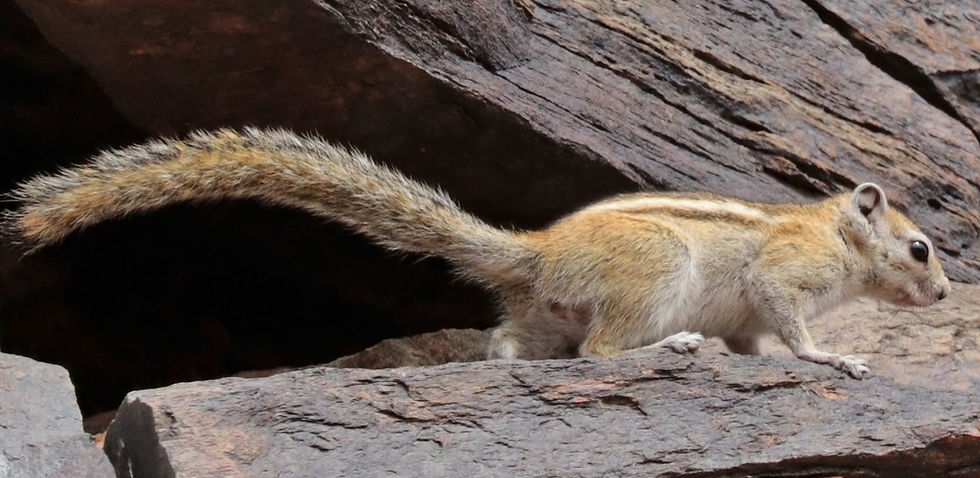
Congo rope squirrel (Charles J Sharp)